

Who I am
I am a software developer and author of computer books. I also work on some problems in theoretical physics. This is my personal Web site where I publish information about:
My professional experience
I received my first software development contract in 1979: My task was to simulate the take-off distance of TU-154 aircraft with engine failure at Budapest airport under various weather conditions, to compute tables of maximum take-off weight. Since then, I worked on many software projects and I am thoroughly familiar with the entire software development life cycle. I authored or co-authored studies for large software projects: For instance, I was one of the authors of the $65M Automation Master Plan of the Canadian Patent Office in 1988. I designed and developed the Windows version of Industry Canada's Integrated Spectrum Observation Centre, with over 120,000 lines of C++ code. I created NORTEC's HELP (Humidification, Engineering and Loadsizing Program), an application for professional engineers and salespersons dealing with large-scale building humidification systems. I also wrote several books on the C++ programming language and the Linux operating system. As part of my scientific research, I independently developed a precision orbit determination program used to analyze the anomalous trajectory of the Pioneer 10 and 11 spacecraft. More recently, I worked under contract with NASA JPL on the Solar Gravitational Lens, investigating the possibility of using gravitational lensing by the Sun to image distant targets, including possible life-bearing exoplanets. I am also one of the maintainers of Maxima, the preeminent open source computer algebra system.
I am just as competent with modern software development technologies as with ancient systems. I routinely switch between developing an interactive app for my Android smartphone and maintaining 50-year old legacy LISP code for Maxima. I am familiar with formal software project management and development methodologies. Last but not least, I also have experience designing and debugging hardware.
Two cannons, aimed at each other and firing at approximately the same time, will result in a mid-air collision, regardless of the weight of the cannonballs or the speed at which they are fired. (Ignoring air resistance.) This is a neat little simulation, created by Claude, demonstrating this. Click the link in the title for some background.
A very nice Claude implementation of Conway's Game of Life, modified with a stochasticity parameter added.
Available for purchase through Patreon
Beyond language and imagery, AI can also generate music. And no, I am not talking about simple tunes on a synthesizer: AI can generate complex sounds, credible vocals in a variety of genres. I was, as a matter of fact, quite surprised how far these capabilities have come.
Recently (summer 2026), I began to experiment with one of the leading AI music creators, SUNO. I thought I was setting a high bar when I asked it to create a rap song about cosmic expansion and the coming Big Rip. I was wrong. Not only did the AI manage to do the job with ease, the phrase, "Big Rip", turned out to be especially well suited for lyrics.
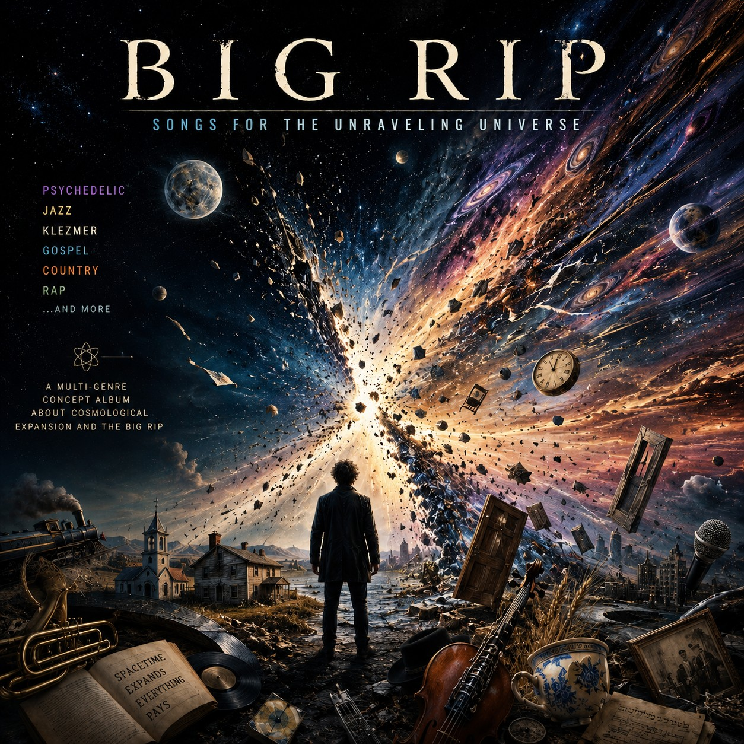
One thing led to another and soon, I used SUNO to create several songs across many genres ranging from medieval chants to Klingon opera. And thus the idea of an "AI concept album" was born.
This is the result... I hope you enjoy the songs as much as I do. The downloadable ZIP archive contains the playable list of MP3 files, FLAC audio and liner notes for a CD case.
Songs and lyrics generated using SUNO (suno.com)
Visual artwork generated using ChatGPT (chatgpt.com) and SUNO (suno.com)
Compilation and liner notes, copyright 2026 by Viktor T. Toth. All Rights Reserved.

